Origins
Settled at the beginning of the 20th century in Congy, our family of peasant origins has always rubbed shoulders with the land through breeding, milk, agriculture, and of course, the vine.
The House
4th generation of Harvester-Manipulant, our estate brings up to date the unique know-how of the elaboration of champagne in its entirety: from the vine to the bottle.
Story
It was at the age of 51 that Henri BRULFERT decided to undertake the production of champagne from his own vines. He then set up his building with a traditional press and began marketing in 1958: Champagne Henri BRULFERT was born. In 1975, he sold his business to his 3 daughters. The youngest, Anne-Marie married Daniel CLÉMENT, from a peasant family and also multi-active. From their union will be born Robert and Serge. Together, the two sons founded Champagne Clément & Fils. Helped by Nicole, Robert's wife, they perpetuated agriculture, viticulture, and the production of Champagne. Then came in 2013, Aurélien, Serge's son, was welcomed and trained by Robert and Nicole in the profession of vine and wine on the family farm. Aurélien carried out his first harvest in 2017 and thus perpetuates the development of Champagne CLÉMENT & Fils.
Tradition
Proud of its values, the estate has kept a lot of tools and craft practices through the generations.
Our work
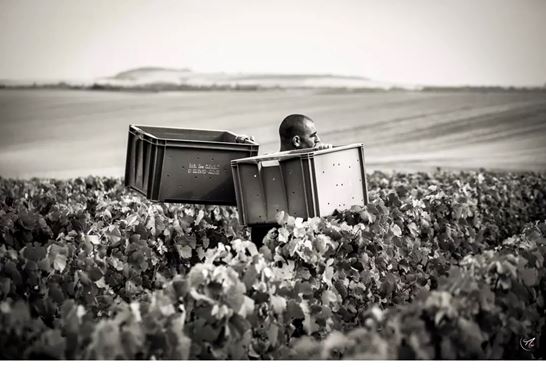
All the steps around the bottle are exclusively done by hand: bottling, riddling, disgorging, and labelling. It is a whole long and tedious work voluntarily preserved in an attention to detail which allows us today to have total control.
Pressing
Our traditional press, always faithful to the post since its installation in 1958 by Henri Brulfert is a unique piece of its kind: MARMONIER brand then converted by COQUARD Presses, its capacity is 4000kG (1 Marc in Champagne unit). He is the last of his generation still active in our village. Supported by a second new generation COQUARD press (inclined plate) since 2017, we have the capacity to load a press every 2 hours, this is the guarantee of obtaining quality freshly picked grape juice. Thanks to these practices, we can now assume and claim an inimitable "house taste" since each stage of the production of our champagnes remains artisanal and therefore unique.
The vineyard
Our family vineyard extends over an area of 6.5 ha including 5.5 ha in the Coteaux Du Petit Morin in Congy and Coizard-Joches and 1 ha in Les Riceys south of Aube.
The slopes of Petit Morin
A link between La Côte Des Blancs and Les Coteaux Du Sézannais, Les Coteaux Du Petit Morin is a wine region in its own right in Champagne.
Resulting from a difference in relief between the Champagne Brie and the Châlonnais plateau, the hillsides face the marshes of Saint Gond, a unique biotope in Champagne where the Petit Morin river has its source. Not very steep reliefs, the region being relatively hilly, the rural landscapes are picturesque and charm its visitors with their simplicity and heterogeneity.
Terroir
The soil generous in clay and abundant in flint, forms a thick layer on the bedrock essential to the development of the roots of the vine: the chalk. Retranscribed in the wines, the clay will bring roundness and fat to the texture while the chalk will tend to bring the minerality and the saline of the champagne so recognizable.
The parcel
We are lucky to have the 3 great Champagne grape varieties, which constitute an interesting range of possibilities in the blends.
The plots whose grapes express themselves particularly better than all the others qualitatively can be subject to drastic selection in order to develop a unique cuvée.
Nature
An inseparable element in our work, we are dependent on nature, sometimes it helps us, and sometimes not, it is nature that makes each vintage different. We owe a lot to nature and our environment, which is why we try every year to improve our farming practices. We are also carrying out trials on our own vines in order to find answers to the environmental needs of tomorrow such as mulching, sowing green manures, no-tillage, or even the reproduction of endemic species.
Every effort counts, we try unpretentiously to find the balance between the well-being of our vines, our soils, and our champagnes.
Our philosophy
Influenced by our peasant culture, our philosophy is to see the soil as "a being in its own right", a partner that guides us through the seasons in our work in the vineyard and therefore in the wine. We learn every day to better understand its fragile and complex functioning bringing a rich biodiversity.